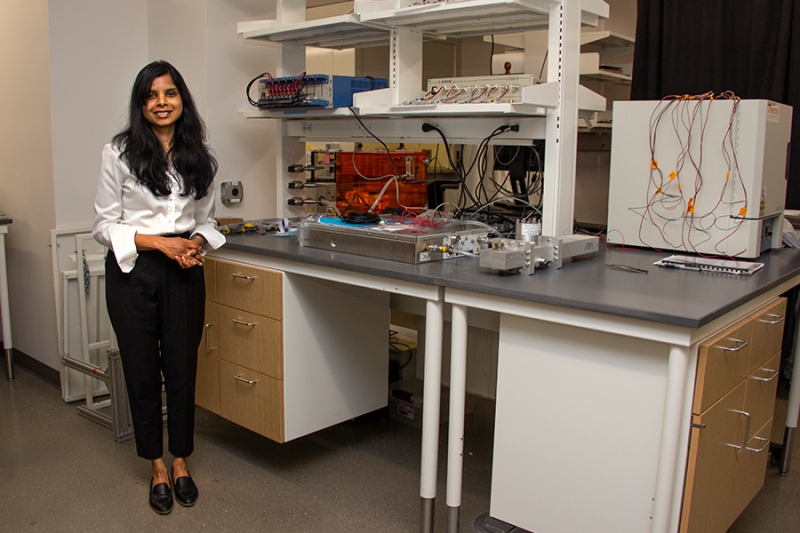
Reeja Jayan works with a team of scientists at Carnegie Mellon University, investigating the future life of spent batteries. Their research direction includes finding new uses for them, and better ways to recycle battery materials. But Reeja has found a way of making batteries last 10X longer, and she plans to turn it into a commercial success.
A Smart Way to Make Batteries Last 10X Longer
Reeja does not believe that repurposing used batteries will resolve North America’s energy problem on its own. We don’t have enough materials to make our own stock, she insists. However, making batteries that last 10X longer would reduce the quantity we need to import.
“When a battery is dead, it’s not dead,” explains Jayan paradoxically. “The minerals are intact, it’s just that you often don’t have the ability to get the current out of them.” Therefore we need a technology that stretches battery life.
Jayan has developed a method that she believes will extend battery life by a factor of ten. We’ll step aside while she explains her idea in non-scientific terms, using lithium-ion chemistry as her example:
- Imagine a battery like a sandwich, she begins by way of introduction.
- The two slices of bread are the positive and negative electrodes.
- The sandwich filling is the electrolyte that controls battery chemistry.
- Lithium ions shuttle back and forth through the electrolyte ‘filling’.
- This is how the battery recharges, and delivers its energy as electricity.
So far so good, Jayan explains. But over time the ions wear the electrodes out. This obstructs the future flow of ions, until the battery eventually dies.
A Polymer Coating to Extend Battery Life Ten Times
Reeja Jayan has developed a polymer coating, that “stabilizes the two pieces of bread, and keeps the ions bouncing around inside the sandwich filling for longer,” in her own words.
This coating is ten-thousand times thinner than a human hair, but can be “shrink-wrapped” around parts of a battery, down to the mineral particles in the electrodes.
This modification prevents the ions wearing out the electrodes prematurely. Yet it would represent just 1% to 3% of the total battery cost.
More Information
Degradation Drivers in Lithium-Ion Batteries
New Factor Causing Degradation in Batteries