Batteries have changed our lives, since they enabled us to take electricity with us everywhere we go. They all do the same thing, by storing chemical energy that they release as electrical energy. There are a number of things about batteries to remember regardless of their type …
There Are Four Essential Parts in Batteries
Any battery contains four key parts whether it is rechargeable or not:
- A CATHODE which is the POSITIVE side of the battery.
- An ANODE which is the NEGATIVE side of the battery.
- A SEPARATOR between the ANODE and the CATHODE.
- ELECTROLYTE allowing chemical energy to flow inside.
Let’s take lithium-ion batteries as an example … their cathodes typically comprise cobalt, manganese, and nickel oxides. While their anodes are the same graphite we find in pencils. This completes the electrodes, that store the active lithium.
Each time we use a lithium-ion battery, several remarkable things about batteries to remember occur:
- Tiny, positively-charged particles of lithium move through the electrolyte from the cathode to the anode.
- Chemical reactions occur simultaneously inside the battery, generating electrons with negative charges.
- That, in a nut shell, is how batteries convert their stored chemical energy to electrical current.
Things to Remember When You Charge Your Phone
Those reactions reverse, when we charge a lithium-ion battery – or any other kind – which could be in your phone or another device. In summary terms, the tiny, positively-charged particles of lithium move back through the electrolyte to the cathode.
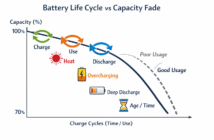
No battery lasts for ever. This is because some of those charged particles don’t complete the journey each time, and ‘fall off the wagon’. As long as enough of these remain, the ‘round trip’ cycle can continue perhaps hundreds of times.
Remember this simple thing about batteries when your phone or another device does not perform properly. That problem is unlikely to be the device. It is far more likely to be the battery, running low on charged particles.
More Information
What Happens Inside Your Battery