There’s a fresh vision on the battery horizon that they call ORION. No, that’s not the Orion constellation group of stars in the night sky. We’re referring to the new ORION group of battery electrolytes, and by all accounts, they could be a winner.
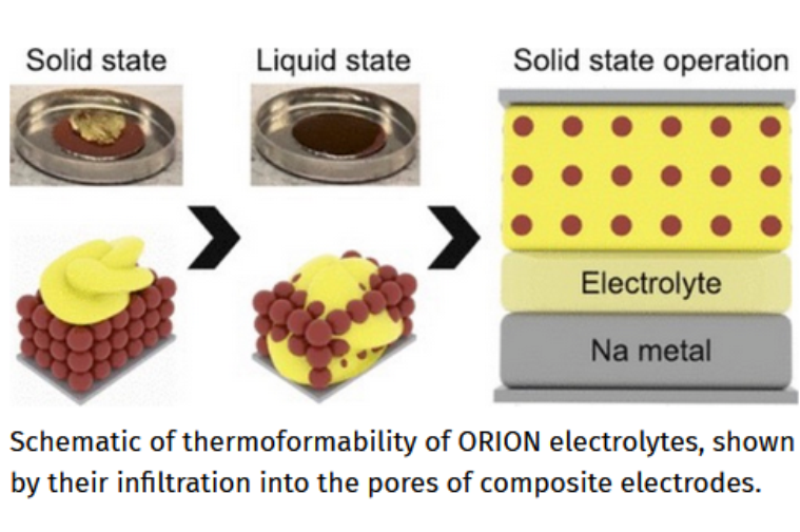
This new battery star is actually a new class of organo–ionic, thermo-formable, solid battery electrolytes, promising safer, more scaleable energy storage. In other words, they adjust in response to heat.
Why Do We Need This Orion Group Of Electrolytes?
Most of the world’s batteries rely on lithium-ion to carry the charges inside them. Solid-state electrolytes help counter these ions’ fundamental instability, but they do have their own problems with cracking. Our supply of lithium metal could also be affected by international relations.
A team at Berkeley Molecular Lab searched for an alternative electrolyte that could melt, flow, and reshape itself. They reasoned it should be able to resist those forces causing solid electrolytes to crack.
But their creative minds did not stop there. What if they could move away from lithium entirely, and use abundant sodium ions instead to carry the charge? They turned this vision to reality with the ORION group of battery electrolytes we referred to earlier.
Turning ORION Battery Electrolytes to Reality
Berkeley Molecular Lab teamed with Pacific Northwest National Laboratory, to get their idea for more scaleable energy storage to work. They had in mind a solid electrolyte that softened when heated, and hardened again when cooled.
Their solution came together as follows:
- They combined zwitter-ions with both positive and negative charges, and a sodium salt NaTFSL
- They then added small ether-based molecules that helped that material to soften and flow.
The result was an electrolyte that softens when hot, but becomes solid at normal battery temperature. The next step in this research involves pairing the ORION battery electrolyte with organic cathodes, in order to eliminate transition metals like lithium completely.
More Information
Solid Electrolyte As Fast As Liquid
Solid Electrolyte Interface Trips Lithium-Metal
Preview Image: How ORION Electrolytes Transform