Sure, lithium-ion batteries rule the roost. Although we doubt they would, if they were not the most powerful solution for portable devices. Otherwise, their tendency to become unstable could have knocked them off their perch. Today we discuss the key to sodium-ion battery sales, the emerging competition.
Is Quantity Not Quality the Sodium Key?
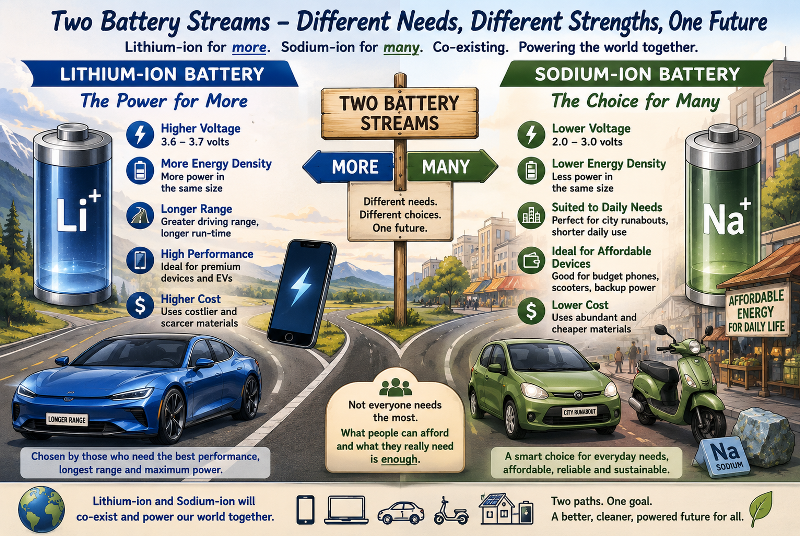
More powerful lithium-ion batteries deliver between 3.6 and 3.7 volts. .Whereas, sodium-ion cells range between 2.0 and 3.3 volts. These volts measure the electrical pressure a battery applies to push its electric current through a circuit.
This is how lithium-ion batteries gained their reputation as the most powerful option for portable electrical devices, Although they do cost more to produce, in terms of the general principle that there’s a cost attached to ‘more’.
This lithium-ion battery ‘more’ translates to greater density for renewable energy storage, and longer electric vehicle driving ranges. However, accepting that we don’t always need those extra volts, could be the key to increasing sodium-ion battery sales.
Signs That Sodium Sales Are Increasing
Wealthier citizens in Europe and North America can often afford the luxury of more volts in their batteries, However, this is not always the case in emerging societies in Africa, South America, and Asia. Their willingness to accept what they can afford could be the key to increasing future sodium-ion battery sales.
The sheer logic of this, is hard to beat. Why pay for a longer driving range, when all you need is a city runabout? Why pay for longer talk-time when you are at work in a busy factory six days a week?
The Emergence of Two Battery Streams
Every society has a wealthy economy for the fortunate few, and a parallel economy for the rest of us. We see signs of a dual battery world emerging for these sectors too.
Perhaps this is why China is pushing sodium-ion battery chemistry so hard. It certainly holds the key to sodium-ion battery expansion in its hands. This is why we believe lithium-ion and sodium-ion batteries may co-exist for some years to come.
More Information