When a sodium-ion battery achieves 500 cycles of recharge and discharge, this gives us fresh hope for this chemistry. Researchers at Pacific Northwest National Laboratory have achieved this goal using a ‘meta-weakly solvating electrolyte’.
That terminology set us back for a while, because we are battery manufacturers, not chemists. So we first needed to know what exactly is a meta-weakly solvating electrolyte, before we could get down to reviewing the research.
Meta-Weakly Solvating Electrolyte And Batteries
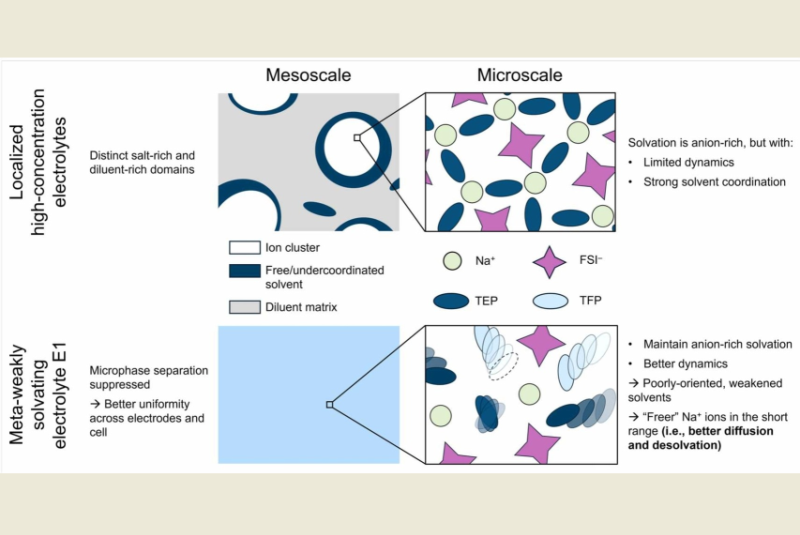
A meta-weakly solvating electrolyte, is a battery electrolyte designed so that the liquid solvent does not strongly cling ions. Instead, the ions interact more with the salt molecules than with the solvent itself.
In regular electrolytes, solvent molecules wrap around the ions tightly, forming a ‘solvation shell’. In a meta-weakly solvating electrolyte though, that grip is deliberately weakened. This changes how ions move, and react inside the battery.
The team from Pacific Northwest National Laboratory, developed a novel meta-weakly solvating electrolyte for sodium-ion chemistry. Their innovation retained an impressive 80% of its original energy storage capacity, after 500 cycles.
When a sodium-ion battery achieves 500 cycles like that, it is way ahead of its competition. This is because other alternatives generally only reach 100 to 300 cycles, before losing 20% of their initial capacity.
Proving the Prototype Sodium-Ion Battery
Of course, the researchers had to prove their claims objectively. They achieved this by scanning the condition of the electrodes, using electron microscopy and energy-dispersive X-ray spectroscopy. This confirmed the following milestones:
- The electrolyte formed a stable interface with a sodium nickel manganese iron oxide cathode, and a hard carbon anode.
- This avoided a historical sodium-ion battery trend, whereby unwanted side reactions form unstable layers.
- Their prototype retained its capacity longer with the lack of these reactions, that otherwise degrade battery materials.
“These results highlight the strong potential of the meta-weakly solvating electrolyte concept for advanced sodium-ion batteries,” the team observes in their research report.
More Information
Fluorine Atoms Fix Sodium-Ion Batteries
Efficient Sodium-Ion Battery is Cost Effective
Preview Image: Graphical Abstract of Work