There’s an old bell chiming at venerable Oxford University, England. It has been doing so since 1840, relying on a pair of pile batteries and Coulomb’s repulsive electrostatic force. IFL Science Technology thinks the bell might finally run down in five-to-ten years’ time. However, this will not disprove the principles of Coulomb’s Law.
The Origin And Proofs For Coulomb’s Law
The ancient cultures surrounding the Mediterranean knew how to rub rods of amber with cat’s fur to attract feathers. In 1600, English scientist William Gilbert identified the difference between this static electricity, and naturally magnetized pieces of magnetite mineral.
By the 18th century, scientists were aware that this ‘electrical force’ reduced with distance in a manner akin to gravity. Joseph Priestly, another English scientist, wrapped this up by declaring the forces between charges varied as the inverse square of the distance.
Other variations and improvements on this theory followed, until French physicist Charles-Augustin de Coulomb published three discoveries about electricity and magnetism. These culminated in a theory that explained the magnitude of the electric force between two point charges.
The Oxford Electric Bell, or Clarendon Dry Pile
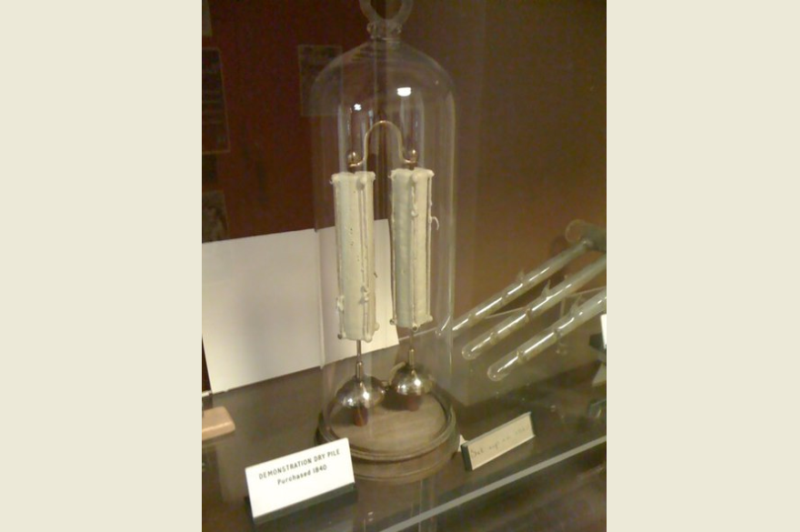
The Oxford Electric Bell, or Clarendon Dry Pile, is a historic experiment to prove Coulomb’s Law in action. The apparatus comprises a pair of brass bells each situated beneath a dry pile battery. Those dry pile batteries, which resemble Alessandro Volta’s original invention, are joined in series, so the bells beneath them have opposite electric charges,
The striker that alternately sounds the two bells is a metal sphere freely hanging between them. The first bell it touches charges the striker with energy from its pile above. The striker is repelled because the two charges match, while the other bell attracts the ball having an opposing charge.
The pile batteries discharge slowly in this process using very little energy. Nobody has examined them because the glass dome is part of the experiment. A layer of molten sulfur conceals the composition of the batteries. Although they could be Zamboni Piles each comprising 2,000 pairs of metal foil discs.
More Information
Oxford Electric Bell Baffles Smithsonian
Alessandro Volta: Father of Modern Battery