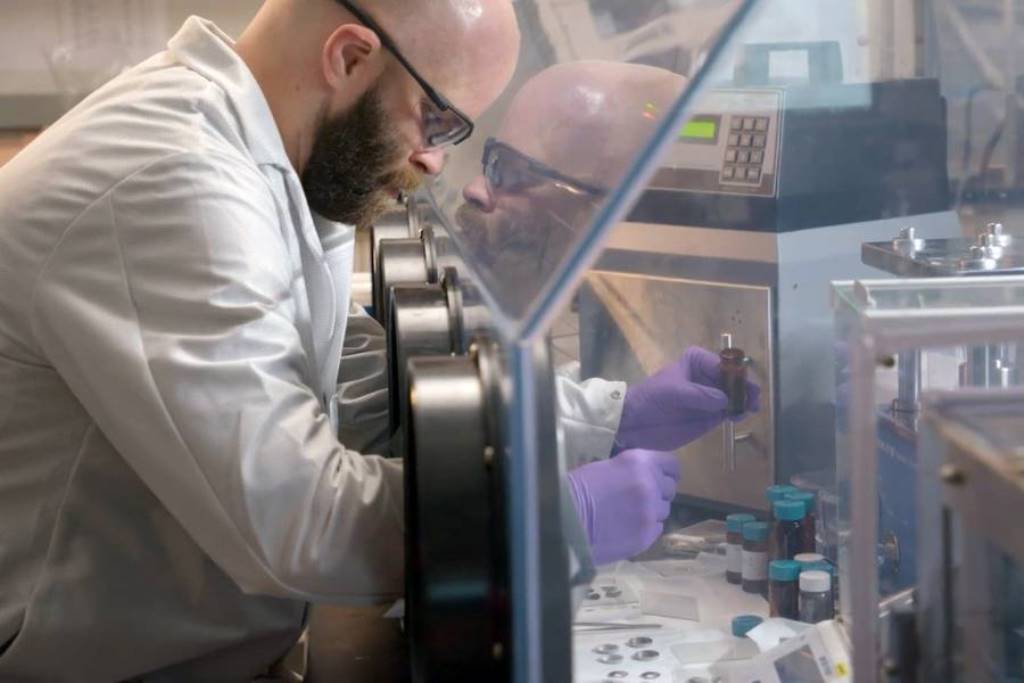
Scientists at John Hopkins University in Baltimore, Maryland have been on the trail of indestructible lithium batteries for some time. They produced a prototype in 2017 that kept working despite them bending, cutting, soaking, and even shooting pellets at it. Now the team at the University’s prestigious Applied Physics Laboratory (APL) has added a fireproof lithium battery to their list of achievements that includes building space vehicles.
A Non-Flammable Electrolyte for a Fireproof Lithium Battery
Commercial lithium battery makers build their cells using combustible and flammable electrolytes. However, these can overheat, catch fire and explode with no apparent warning. The John Hopkins team says the Galaxy Note 7 incident was a no-brainer.
Furthermore, banning e-cigarettes on U.S. Navy ships was a logical response to a known risk. The only way to make a fireproof lithium battery, they concluded is to change the original John Goodenough recipe. Significant safety advancements have become essential as the technology ripples through grid storage and electric vehicles.
New Water-in-Salt (WiS) and Water-in-Bisalt (WiB) Electrolytes
The John Hopkins University APL team in Baltimore, Maryland has discovered a new class of WiS and WiB electrolytes. These have a remarkable impact when they incorporate them in a polymer matrix. Water activity reduces, while battery life cycle improves and energy capability increases to four volts. Moreover, the new electrolytes have eliminated the toxic, flammable, and highly reactive solvents in current lithium-ion batteries.
The result is a fireproof lithium battery with enhanced performance characteristics, they say. It is also more stable and resistant to damage than their 2017 version. The University’s Applied Physics Laboratory researchers hope to advance to the prototype phase within a year.
We hope their discovery moves us towards eliminating the flammable lithium salts and toxic liquids in today’s lithium batteries. Aqueous batteries have been with us for a while now. However, this seems to be one of the few really promising examples to date.
Related
Adding Salt to Lithium Metal Electrolyte
Batteries Made From Water To Fuel Our Needs
Preview Image: Battery that Won’t Catch Fire
Video Share Link: https://youtu.be/lIgctE_Clqk