

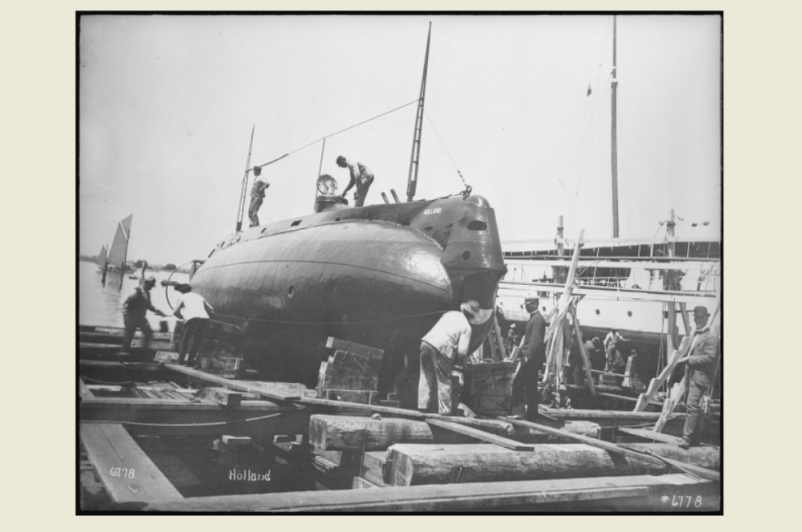
The first submarine vessels used human effort to propel them across, and through the ocean. Then, in 1863 Spanish engineer Narcís Monturiol launched his Ictíneo II. This used a reaction of zinc, manganese dioxide and potassium chlorate to heat the boiler of a steam engine. But this was not pure electric submarine power yet.
John Holland Invents Pure Electric Submarine Power
The U.S. military became interested in underwater vessels after Englishman Robert Whitehead devised a ‘locomotive torpedo’. Irishman inventor John Holland was quick off the mark with a suitable model submarine in 1876. Several false starts later he launched the first electric submarine he named the Holland Type VI in 1897.
His Holland Type VI used a conventional combustion engine while on the surface. But it switched to electric battery power as soon as it prepared to submerge below the water. The U.S. Navy snapped up the innovation, and recommissioned it USS Holland on April 11, 1900. This set the tone for military submarines that remained unchanged until the advent of nuclear power.
The Electric Specification for USS Holland
USS Holland was 53 feet long with a beam 10.5 feet wide, and a complement of 6 crew. Its electric motor delivered 75 brake-horse power, and it was capable of 35 miles at 5.5 knots when submerged under water.
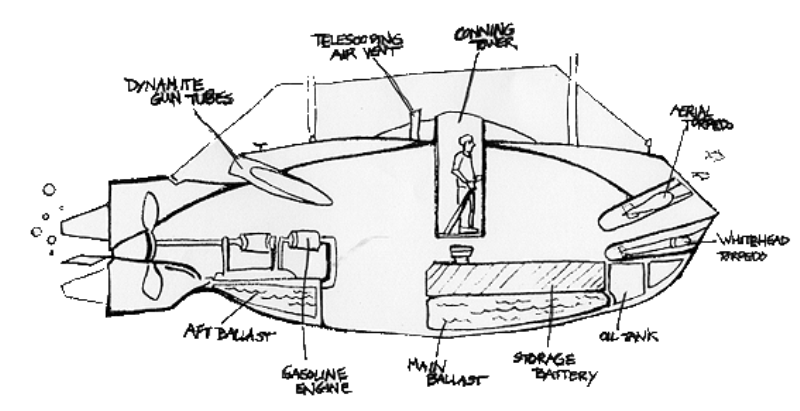
The USS Holland boasted an Electro Dynamic 37 kW electric motor, for submerged operation driving a single propeller shaft. This drew power from a 66-cell Exide battery of unknown design but possibly lead-acid. This system’s performance varied between accounts. One version has it the motor delivered 56 kW when driving the vessel forward underwater.
Whatever the case may have been, John Holland’s electric submarine evidently was a great success. That’s because the U.S. Navy ordered several more vessels of the same design according to Wikipedia.
The original vessel and its successors apparently provided invaluable opportunities to train a new breed of submariners. Sadly, they broke her up for scrap in 1932, after displaying her in a public park for 22 years. And as a result all we have left are a few photos, drawings and memories.
More Information
Gustave Trouvé Launches Battery Electric Boat
Moritz von Jacobi Demos First Electric Boat


