Moritz von Jacobi was a Prussian engineer working largely in the Russian Empire, and an extraordinary member of Imperial Academy of Sciences. He studied architecture in Göttingen, before engaging in physics and chemistry which became his lifetime passion. We remember him best for his studies on electricity, and its various practical applications.
Moritz von Jacobi Worked Largely in Isolation
Moritz von Jacobi spent most of his time in Saint Petersburg, on the Gulf of Finland fringing the Baltic Sea. This meant his work had little effect on the main centers of knowledge in France and England, although he published widely. Perhaps the truth of the matter was he was simply too far ahead of his time.
He developed a deep interest in electro magnets, in other words soft metal cores activated by electrical current passing through. His particular interest lay in the current, wire thickness, number of turns, and diameter and thickness of the iron core. This laid down important principles for future electric generators and motors.
The Key to His Work Was the Humble Battery
There were no power stations and electricity grids in those olden days. Moritz von Jacobi worked by lamplight and candlelight through long Russian winters, with a fire flickering in the hearth for warmth. He had to produce his own electricity for his experiments. However, exactly how he did so is tantalizingly vague.
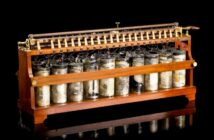
We unearthed a clue in the Oxford Reference data base. There we learned Jacobi’s first electric motor had copper and zinc electrodes, and sulfuric acid electrolyte. From this it seems likely to have been a galvanic cell using principles laid down by Allessandro Volta and William Sturgeon. We imagine he built his own batteries for his experiments.
The World’s First Electric Boat Takes to Water.
The world’s first electric boat was actually a test bed for Moritz von Jacobi’s electric motor. Our image provides a tantalizing glimpse of how it worked, and we have placed a ring around what we believe were the battery cells. After rigorous testing he determined which version consumed the least zinc, and was ready to go live in 1839.
Czar Nicholas the First, supreme ruler of Imperial Russia bankrolled the cost of a twenty-eight-foot-long electric boat. This proved able to carry 14 passengers against the current of the Neva River at three-miles-per-hour. We can’t say for sure what the river craft looked like, or whether it used a screw or a bladed propeller. So we’ll have to leave that up to your fertile imagination!
More Information
World’s First Zinc Chlorine Flow Battery
Tissandier and Chromate Acid Cells Fly