The Henney Kilowatt electric car came so close to becoming the first mass production version in 1959, it was tantalizing. However, as it turned out the consumer interest simply was not there. You see, only a few scientists had stumbled over looming global warming. And as for politicians, green energy was hardly a great political slogan when everything seemed to be going so well with gasoline so plentiful.
Was Henney Kilowatt a Renault with a Battery?
The similarity certainly was striking when viewed from a distance. This was because the Henney borrowed many body parts from the contemporary Renault Dauphine. However, the designers Viktor Wouk, Lee DuBridge and Linus Pauling had a different vision for what went on beneath the gleaming paintwork.
Various players brought their contributions to the party. Vacuum cleaner makers Eureka Williams contributed the electric motor. While Henney Coachworks fabricated the chassis and the body based on the original Renault Dauphine. And the batteries? The MK1 version used 18 by 2-volt batteries delivering 36 volts, but there was more to come.
More About the Technology and the Brave Idea
The Henney Kilowatt performance must have disappointed the market, because the MK2 version boasted 12 starter batteries. These were 6-volt in series delivering 72 volts under the watchful eye of a solid-state controller. There was also an auxiliary battery for lighting and control.
The front and rear compartments shared the batteries to balance load. While the electric motor was now a 7-hp General Electric DC version. Driving range was 60 miles when driven with care, although this was not the case at the 60 miles-per-hour top speed.
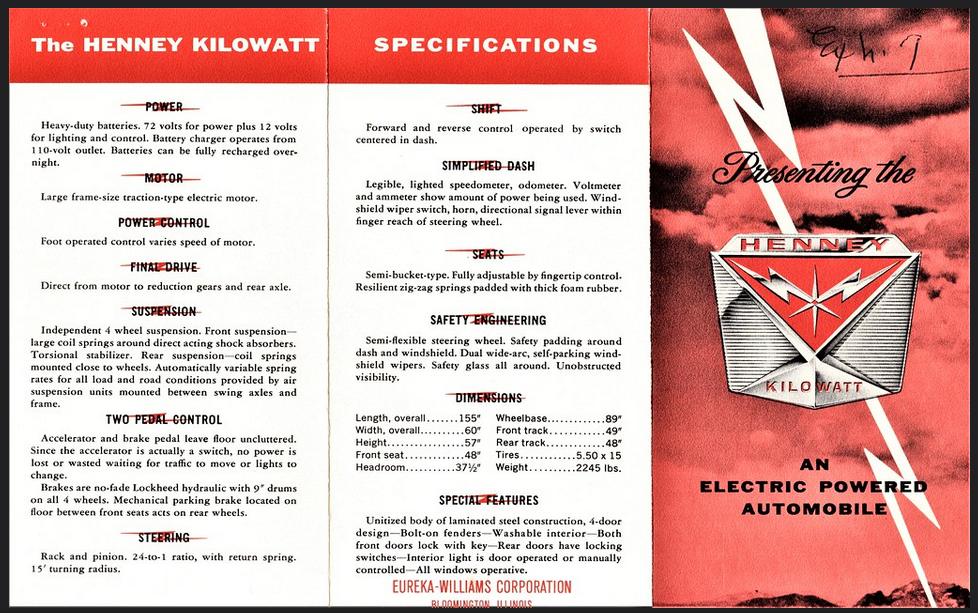
However, America’s drivers were less than interested. Between 1959 and 1961 only 47 Henney Kilowatt owners paid the price. Most of them were electric utilities who used them to promote their core business, which was grid supply.
Perhaps the Packaging Was the Problem
The Renault look-alike discontinued in 1961. Perhaps this was because it could not compete with the combustion version’s driving range and performance. So instead, the brave Henney turned out to be little more than a curiosity. It was also more expensive than the Renault Dauphine. Such a pity when we consider how global warming was accelerating at that time.
More Information
Milk Floats Keep Electric Transport Alive