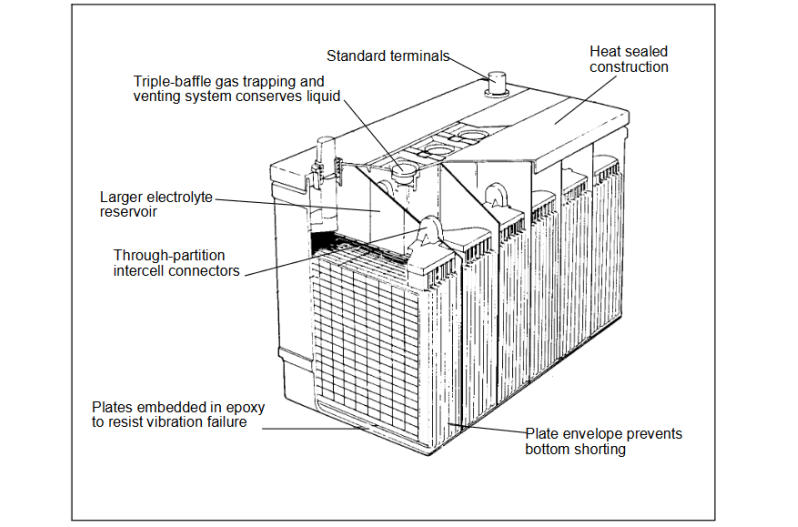
Lead-acid battery operating principles depend on their active materials controlling charging and discharging. These include an electrolyte of dilute sulfuric acid (H2SO4), and a negative and positive electrode. The former is sponge lead (Pb) in a fully charged battery, while the latter is lead dioxide (PbO2).
Operating Regime of a Lead-Acid Battery
Flooded, sealed and valve-regulated versions all adhere to the following lead-acid battery operating regime.
- The positive sponge lead, and negative lead dioxide react with the dilute sulfuric acid to form lead sulfate and water during discharging.
- The lead sulfate on both electrodes converts back to lead dioxide and sponge lead respectively upon recharging.
- Meanwhile the sulfate ions return to the electrolyte to become sulfuric acid. This process repeats numerous times for the life of the battery.
The Impact of Discharge Rate and Temperature
Lead batteries are not as stable as might seem at first sight. Indeed, both operating temperature and discharge rate may have a profound impact on lead-acid battery operating efficiency. Slower discharge rates also lead to greater capacity.
Higher operating temperature is also detrimental to these batteries, especially above 130F / 55C. There are three factors at play here, namely corrosion, lead solubility in hot water, and a higher rate of self-discharge. This dynamic may also increase the charge input necessary to offset normal and self-discharging.
Storage, Transport and Disposal of Batteries
Lead batteries currently not in use should be disconnected with their terminals isolated. However, they should not self-drain or discharge to a low level because this could cause permanent damage. Store them fully charged in an upright position, and check and recharge them regularly in well-ventilated space.
Always return lead-acid batteries to a supplier when their life is over. Their lead-acid battery operating days may have come to an end. But their materials can recycle, and find fresh lives and new purposes.
More Information