Are we obsessed with the need to make smaller, and smaller battery cells with more and more power? Smaller is great for power-to-size and power-to-weight ratios, but this limits the materials we can use. The energy-powerful ones always seem to cost more. An Iowa professor is challenging the assumption that batteries must always be smaller, and we decided to share his ideas here.
Setting Aside the Need for Smaller Batteries
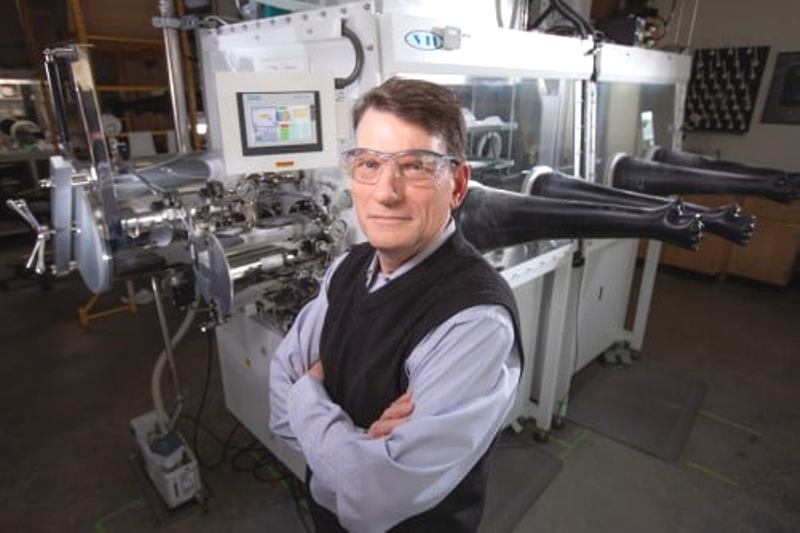
So let’s pause the assumption that we need small batteries, which is true for hand-held devices. Steve Martin at Iowa State University has been studying battery materials for four decades, and so he knows his stuff.
Here are the battery materials Iowa State University researchers are considering under his guidance as we write:
- Sodium, which is abundantly available, and 1,000 times cheaper than lithium.
- Waste glass sourced from a garbage recycling company situated near the university.
- Stable, high-carbon biochar from heating biomass to produce alternative fuels.
- Sulfur removed from crude oil during refining, to prevent corrosion during use.
The Iowa State University researchers plan to design a battery to store and discharge wind energy, using those inexpensive materials we mentioned. They will keep an eye on size too, but this will not dictate the design, because batteries do not always have to be small.
How These Larger Batteries Will Work
The battery cathode will be sulfur, and the anode biochar, while the separator will be sodium-conducting glass, Steve Martin explains. He is Iowa State Anson Marston Distinguished Professor in Engineering, University Professor in Materials Science and Engineering, and indeed the project leader.
The project goal is to build an ‘ultra-low-cost’, ‘ultra-high-performance’ battery to store wind energy, using local materials. We don’t suppose it will be the end of the line, if the result is larger than sodium or lithium-ion, given the large footprint of wind turbines.
This research project will form the basis of doctoral theses for two Iowa State University students. We hope their work is successful, and that it leads to rewarding careers for both of them.
More Information
Palm Oil Biomass Stop-Gap Energy Source
Simpler Sodium-Sulfur Batteries in Lab