Scientists at SLAC-Stanford Battery Center report significant benefits from supercharging new lithium batteries before they reach customers. According to the SLAC report, this technique could increase lithium-ion battery lifespan by 50%. Just imagine how this could boost new electric car sales!
Effects of First Charging New Lithium-Ion Batteries
We have known of the importance of a lithium-ion battery’s first charge for a while. We could even call it momentous, because the initial burst of energy affects how long the battery will last. This effect is particularly powerful in terms of the number of recharge / discharge cycles it will sustain.
The SLAC-Stanford Battery Center researchers discovered that factories normally give their lithium-ion batteries their first charge at regular current levels. Although, when the scientists tried supercharging new lithium batteries instead at ‘unusually high currents’, then:
- The charging time fell from 10 hours to just 20 minutes.
- The batteries’ average useful lifespan improved by 50%.
The Battery Center scientists then decided to find out what was causing this remarkable improvement in lithium-ion battery lifespan. And so they used ‘scientific machine learning’ to pinpoint the root cause.
The results pinpointed specific changes in the battery electrodes, that accounted for the improved performance. This discovery could prove invaluable for innovative manufacturers wanting to improve their products.
The ‘Squishy Layer’ That Improved L-Ion Performance
The battery scientists were excited, but they needed to know more. And so they built special pouch cells in their laboratory, comprising positive and negative electrodes surrounded by an electrolyte solution.
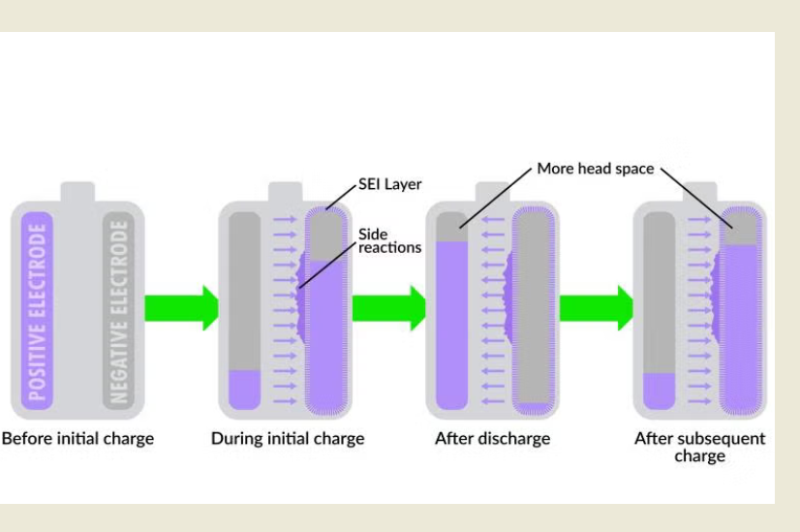
The team already knew that a lithium-ion battery loses some of its lithium ions every time it cycles. A far greater number of these went missing while supercharging new lithium batteries at high current. Except this time the ions did not vanish completely.
Instead, they resurfaced as a new ‘squishy’ layer on the solid electrolyte interphase, that forms on the negative electrode during the initial charging cycle. This addition protected the negative electrode from side reactions. These would otherwise have accelerated further lithium-ion losses, causing the battery to degrade faster.
More Information
Solid Electrolyte Interface Trips Lithium-Metal
Magnesium Ions Dance Through Solid Electrolyte
Preview Image: Supercharging New Lithium-Ion Battery