Our T-Cells appear to be effective in mounting an immune response against Omicron, according to Eurek Alert on January 3, 2022. T cells are a match for Omicron, the American Association for Advancement of Science journal continues, despite all the mutations. This is according to new research by Hong Kong University of Science and Technology, and University of Melbourne.
Refresh My Memory Please – What Are T Cells?
T-Tells are a special type of white blood cell playing an essential role in our adaptive immune system. They migrate to the thalamus in our brain when they are young, hence the letter ‘T’ in the name. There they learn to seek out and destroy particular diseases. COVID-19 vaccines accelerate this process by pretending to be genuine infections.
Our immune systems maintain a small reserve of trained T Cells after the real, or simulated infection has passed. However, if a similar infection returns later they multiply rapidly into large numbers. Then they become an ‘army of foot soldiers’ that seek out and destroy infected cells. This new research confirms T Cells are a match for Omicron infections too.
Eurek Alert Says Omicron is Not a Match for T Cells
However, T-cells are not the only player in our immune system. We also have Specific Antibodies that develop during an infection, or after a vaccination. Their job is to stop the virus taking hold in our bodies.
Specific Antibodies and T-Cells enable our immune system to deliver a ‘double knockout punch’, in theory at least. That’s because scientists have discovered the Omicron variant has ways and means to partly bypass our Specific Antibodies. They had been concerned the secondary T-Cell response might not hold either.
However, the researchers at Hong Kong University of Science and Technology, and University of Melbourne confirm that this is not the case. We are coming closer to understanding why Omicron symptoms are generally milder, despite it being so highly infectious.
Breaking News
Why You May Not Want Your Vaccine
Are We Moving from Pandemic to Endemic?
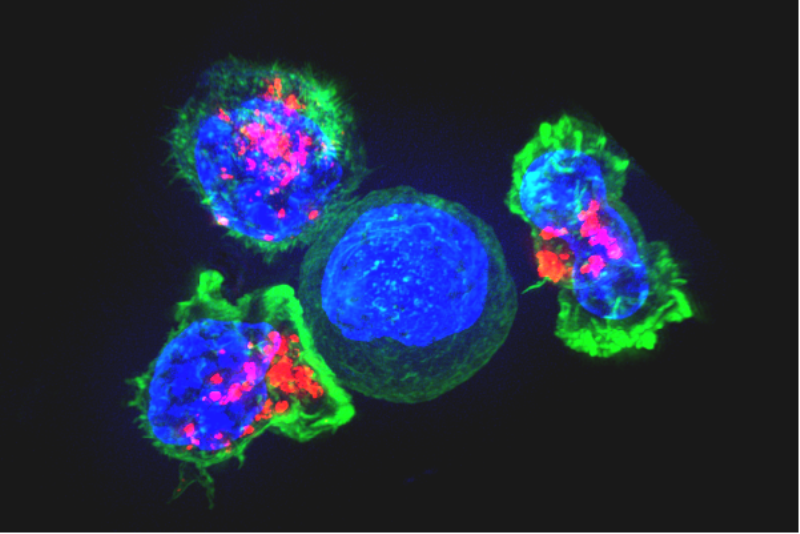
Preview Image: A Group of Killer T Cells