Thomas Edison had a preoccupation with electricity from his early days as a telegraph operator. He even chose night shifts so he could experiment with lead-acid batteries. One night in 1867 when he was aged just 20, he spilled acid onto the floorboards. This seeped through and dripped onto his boss’s desk below. Exit job. But drum roll please for Thomas Edison’s Nickel-Iron battery experiments.
Thomas Edison’s Nickel-Iron Search Begins
Edison began searching seriously for an alternative to lead-acid technology in the 1890’s. His end-goal was a rechargeable battery the industry sometimes referred to as an ‘accumulator’. He wanted something compact he could use in phonograph gramophones, and perhaps later in electric cars too.
By now Edison was a prolific innovator with income flowing from some of his ideas. Wikipedia believes he may have tried as many ’10,000 combinations’ before settling on nickel-iron (NiFe). Perhaps he also had access to the 1899 patent for a similar battery by Swedish inventor Waldemar Jungner.
Whatever the case, Edison successfully saw off a Jungner patent registered a month earlier, and concentrated on commercializing his copyright. He founded the Edison Storage Battery Company, and by 1904 he had some 450 people working there.
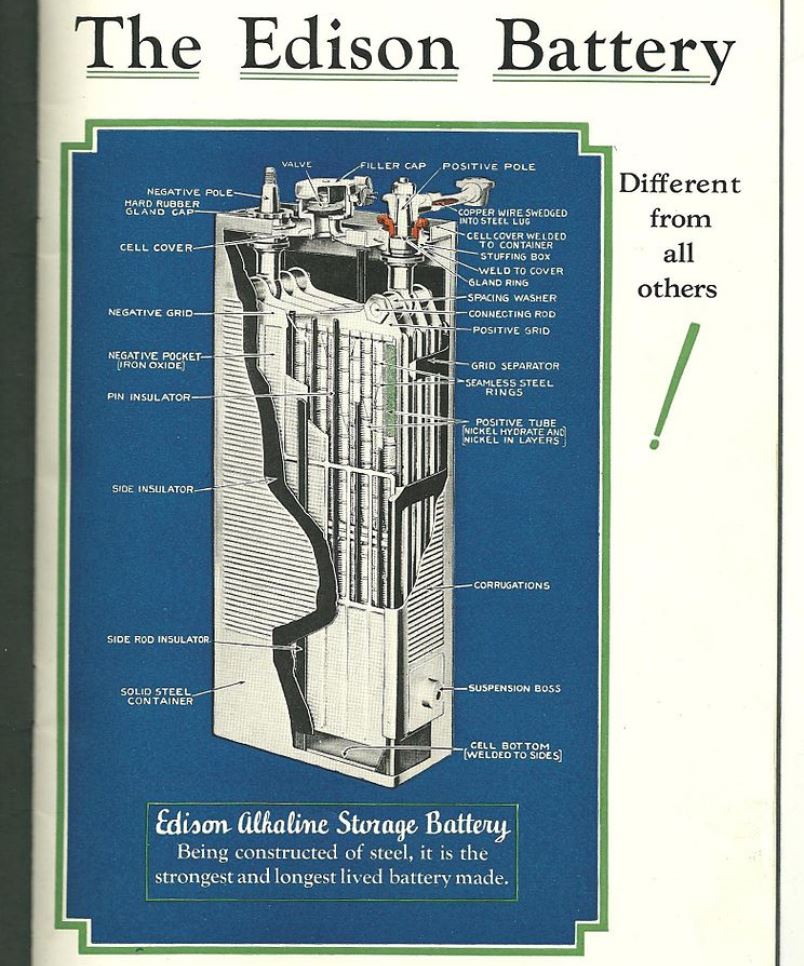
Mixed Fortunes for Edison’s Nickel-Iron Batteries
Edison’s first rechargeable nickel–iron batteries targeted the fledgling electric car market. However, defects plagued early batches, and customers changed brands complaining about failures.
Money became tight as the company exhausted its own resources. Eventually Edison had to fund operations from his own pocket. He finally produced a ‘very efficient and durable nickel-iron-battery with lye as the electrolyte’ in 1910 according to Wikipedia.
How Edison Came to the Party Too Late
But by then electric starters for gasoline engines were rolling out, and these soon took over from electric motors. This signaled the end of Thomas-Edison’s nickel-ion endeavors in that regard.
However, Edison’s battery achieved greater success in other applications. These included electric and diesel-electric rail vehicles, backup power for railroad crossing signals, and even lamps used in mines.
More Information
Waldemar Jungner Invents NiCad Battery