Previous Mars missions have focused on whether the planet might have conditions able to support life. However, the 2020 Mars mission, landing there in 2021 will look for evidence of historic biology in rocks once at the edge of an ancient lake. While NASA ponders over the possibility of extinct life, a tiny Mars chopper will be testing its wings.
An Important Task for the Tiny Mars Chopper
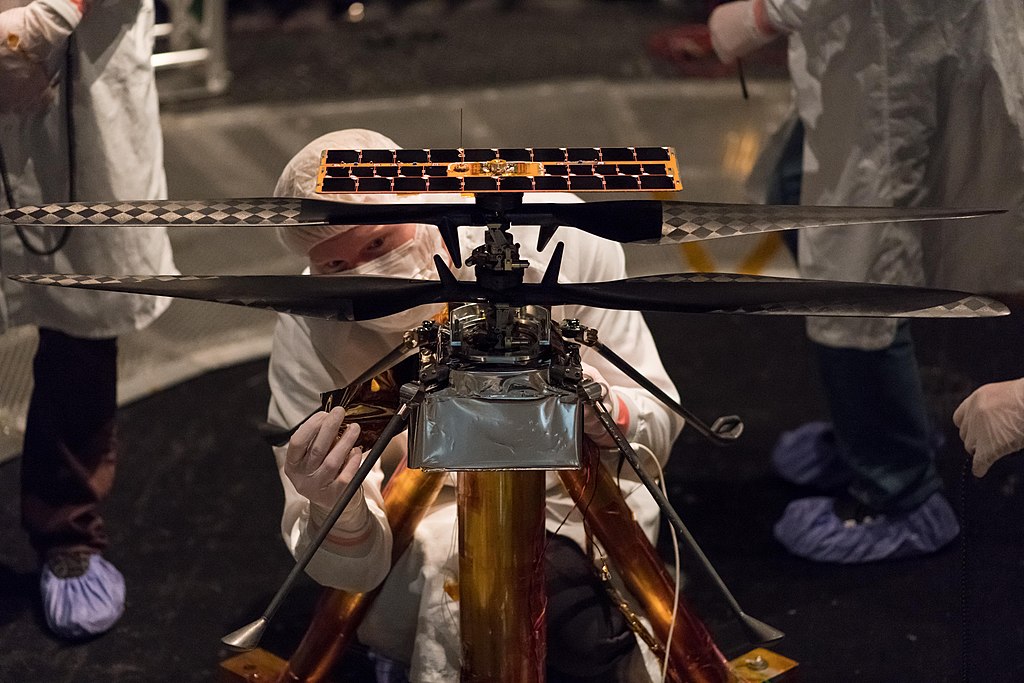
NASA engineers believe the Mars atmosphere will be able to support the tiny helicopter weighing just four pounds. They hope this will speed up the rate of exploration, however this time it’s a case of baby steps first. Motive power will come from counter-rotating coaxial rotors about 3.25-feet in diameter.
They will position their tiny Mars chopper on the belly of the rover beneath a shield to protect it during landing. The rover will release the flying vehicle under orders from flight control when engineers decide the time is right. The Scout, as they call their device will not carry any scientific instruments. It will however relay contextual photographs during five short, three-minute flights. If all works out then helicopters will feature in future missions to planets, moons and smaller bodies with atmospheres.
More Information about the Mars Helicopter Scout

The Scout is the foundation on which NASA will build more capable helicopters carrying scientific instruments. Short flights will spread over a month to allow solar panels to recharge six Sony li-ion batteries with a nameplate capacity of 2 Ah. Communication will be via the rover using two flight-control micro-controller units.
Assembly is proceeding smoothly thanks to additional funds in the March 2018 federal budget. Therefore the vehicle is currently undergoing extensive flight-dynamics and environment testing. Signs are positive it will fly on Mars in 2021. The main mission will focus its attention on the 30-mile-wide Jezero crater that ancient water flows suggest was once a giant lake.
The mission rover will examine the chemistry of rocks for signs of ancient biology. While the tiny Mars chopper tests its wings over the enigmatic red planet.
Related
Insight Power Supply for the Mars Lander
Rest Peacefully, Mars Opportunity Rover
Preview Image: Planned Autonomous Aerial Scout