Situations may spin out of control when lithium-ion batteries fail. The key is to study dendrites as it develops, so we can understand the process better. Scientists at Washington University in Missouri, have found a way to observe the process using high-fidelity microscopy in real time.
How Lithium-Ion Batteries Fail
Lithium-ion chemistry has embedded itself in our society, and become the dominant player in electric cars and bulk energy storage. Both these industries demand longer battery life between recharging, and greater energy storage capacity.
These twin demands pile more pressure on a chemistry already performing close to its limits. The research report in Wiley that we link to below, confirms how these twin requirements ‘pose significant challenges to battery cycle life and safety’.
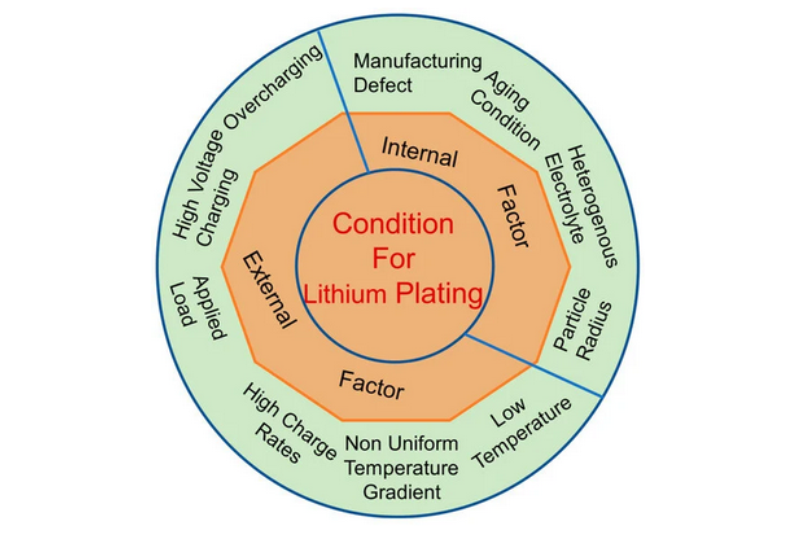
The onset of lithium plating marks the point when dendrites appear, and lithium-ion batteries begin to fail. This phenomenon occurs when some lithium molecular ions permanently adhere to the anode surface, instead of slipping in and out of the material layers.
This plating is the direct result of fast battery charging at high states of charge, and low ambient temperatures. Repetitive plating adds dendrite layers that can reach through the separator, short-circuit the terminals, lead to rapid, irreversible capacity loss, and even induce thermal runaway.
The First Counter-Measure is Detection
The researchers at Washington University in Missouri, reasoned that the first step to tackling lithium plating was detecting the onset early. They knew this would not be easy, because the process occurred at atomic level.
And so they constructed transparent lithium-ion batteries in narrow glass tubes, that replicated the geometry of actual lithium-ion batteries. This made it possible for them to observe plating using high-fidelity microscopy.
The team used a novel ether-based electrolyte to complete their experimental model. Then they gradually stepped up the charging capacity to the point that the first dendrite plating appeared. This then marked the point beyond which lithium-ion batteries may fail.
More Information
Watching Dendrites Grow in Real Time
Understanding Lithium Dendrites Threads