George Leclanche was a French electrical engineer we commemorate for his invention of the Leclanche Cell. He qualified as an engineer in 1850, and then worked for a French railway company. There he was in charge of communication infrastructures affecting electrical transmission speed. It was almost inevitable he would want to improve this situation.
Leclanche Cell Launches New Generation of Batteries
Leclanche soon discovered the existing generation of battery cells were inadequate for their task. However, before he could do anything about it, he had to move to Belgium for personal reasons. He built a small laboratory in his new home in Brussels where he could work on a solution.
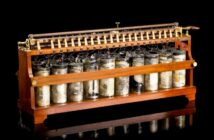
He came up with the idea of a ‘wet’ battery cell with zinc anode and manganese dioxide cathode in 1866, which he wrapped in porous material dipped in a jar of ammonium chloride solution. This delivered 1.4 volts after he added a little carbon to the manganese dioxide cathode.
The local railway companies liked what they saw. They soon adopted the Leclanche Cell as their go-to choice for telegraphy, signaling, and electric bell work. With the wisdom of hindsight we now know we have Leclanche to thank for the zinc-carbon cell. This was to become the world’s first popular battery.
How Leclanche’s Device Almost Came Together
However, the ‘wet’ electrolyte limited the cell’s portability, and hence usefulness. And so Leclanche modified it by adding starch to the ammonium chloride electrolyte. This made it ideal for early telephones, because they had to be self-sustaining electrically. However, he had not found the perfect solution yet.
This was because the Leclanche Cell was only suitable for short conversations before it ran flat, terminating abruptly. That was due in turn to certain chemical reactions in the cell increasing internal resistance, and thus lowering voltage. Other people would have to come to the fore to carry his inspiration further, and they did in the course of the decades following.
More Information
Experiments in Science: The Grove Cell