Aqueous zinc batteries with water-based, liquid electrolytes, could become a great option for temporary grid electricity storage. But first, science would need to find a solution for their limited electrochemical stability. Managing the water in zinc metal batteries could solve this challenge, and broaden their operating temperature range too.
Proposal for Controlling Water in Zinc Batteries
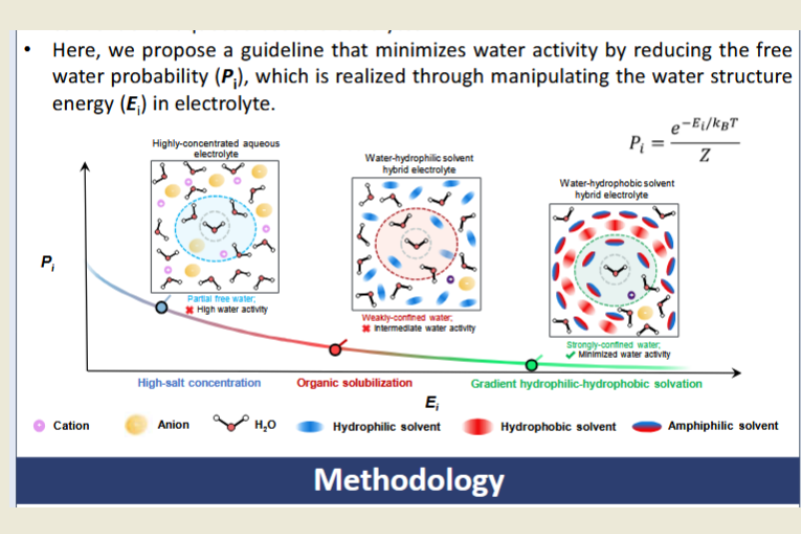
The researchers came together from a variety of universities in China, that are too numerous to mention here. Their method involved minimizing water activity in aqueous electrolytes, through a combination of hydrophilic and hydrophobic strategies.
Let’s pause here for a moment and consider what these terms mean in practice. ‘Hydrophilic’ refers to substances that mix readily with water. While ‘hydrophobic’ means substances that repel water instead.
The scientists from China nano-engineered the following to minimize water activity, and resolve the two hurdles we mentioned earlier:
- The team confined the water molecules in a hydrophilic–hydrophobic water solvation sheath.
- In solvation, a liquid surrounds and “hugs” a substance’s particles, like water wrapping around sugar as it dissolves.
- The hydrogen bonded with hydrophilic groups in the inner solvation layer, suppressing water decomposition.
- While the hydrophobic solvents in the outer solvation layer repelled water molecules that might otherwise have entered.
This approach to managing water in zinc metal batteries was highly successful. The scientists report over 99% zinc plating-stripping, over 4,000 charge-discharge cycles.
Looking to The Future of Water-Based Electrolytes
The researchers believe their discovery extends beyond the particular chemicals they used in their experiment. They visualize applying other hydrophobic-hydrophylic pairs, to achieve low water activity in aqueous electrolytes.
The scientists are now using artificial intelligence to zoom in on more efficient and cost-effective pairs. They believe raw-material pricing, synthesis scalability, solvent recovery, and supply-chain availability will all have a role in managing water in future zinc metal batteries.
More Information
A Salt to Remove Free Water Molecules
Hydrogen Bonds In Aqueous Batteries Exposed