

All the world’s COVID virus would fit in a Coke can, with plenty room to spare. So said Christian Yates, senior lecturer in mathematical biology University of Bath, when a reporter’s curiosity got the best of them. However, he confided with The Conversation that he asked his wife’s advice first. Either a teaspoon or an olympic-size swimming pool would be my best guess, she replied.
Step One: Assemble the Data (Not Simple)
The quantity of COVID virus in an infected person increases each day, until it starts to decline on day six. The number of infected people is uncertain in terms of data. However, Christian Yates took Institute for Health Metrics and Evaluation’s advice and pegged it at eight million.
Then he extrapolated the result using high-end data of infected monkeys. This put the total at roughly two quintillion virus particles in the world at any one time. Or should we say 2×10¹⁸ (or two billion billion) for digitally minded people. But this still did not tell him whether the world’s COVID virus would fit in a coke can, a teaspoon, or an olympic-size swimming pool.
Proving the World’s COVID Virus Would Fit in a Coke Can
This is entirely, theoretically possible because the radius of individual virus particles is roughly 1,000 times thinner than a human hair. You may not need to know the formula V = 4 π r³/3 to convert this to the volume of a sphere. But we decided to mention it for the sake of completeness.
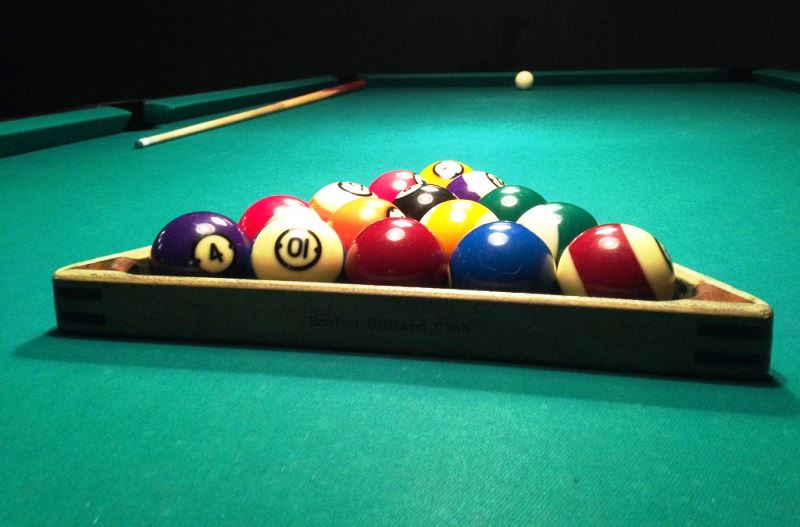
However, Christian Yates still had one more calculation to do. This was to allow for the wasted space between the particles, because they are theoretical spheres like billiard balls. But, this would still not completely fill a Coke can. At this stage our analog brains turned on and asked, which capacity Coke can was that?
Origin of the SARS-CoV-2 Virus Unraveling
Bats and Pangolins With CORONA Antibodies
Link to Article for Mathematically Minded
Preview Image: Billiard Balls in a Rack


