

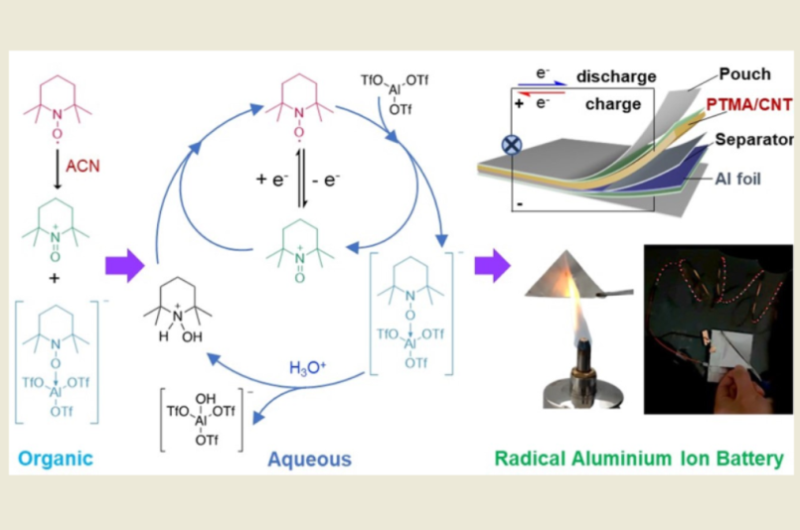
Radical batteries are potentially more environmentally friendly, because they shun the use of toxic metals including lead, cadmium and mercury. Teams from Flinders University in South Australia, and Zhejiang Sci-Tech University in China have joined forces in that direction. They have been quietly developing a new class of radical aluminum _batteries, and this may be a significant breakthrough.
More About How Radical Aluminum Batteries Work
Radical batteries have failed to enter production, despite the idea being first proposed back in 2005. Wikipedia ascribes the delay to difficulty synthesizing an appropriate negative electrode. However, if this challenge could be overcome, then radical aluminum batteries could become a high-power alternative to lithium-ion batteries the authority source believes.
The international team from Flinders and Zhejiang Sci-Tech universities first experimented with a variety of stable radicals. And then they combined forces to develop the first prototype with the following characteristics:
- An aluminum-ion battery using fire-retardant, air stable, water based electrolyte.
- Delivering a stable voltage output of 1.25 V, and a capacity of 110 mAh g–1.
- And able to deliver this over 800 cycles, with only a 0.028% loss per cycle.
Zhongfan Jia is associate professor at Flinders University College of Science and Engineering. He told Chem Europe he hopes to use bio-degradable materials in future in soft pack versions, to make the product safe and sustainable.
More About the Green Nature of this Breakthrough
We are entering a phase in global warming where environmentally-responsible batteries are becoming mandatory. Multi-purpose metals such as aluminum, zinc, and manganese are fast becoming preferable to scarce lithium and cobalt.
“In particular, aluminum-ion batteries attract great attention because aluminum is the third most abundant element at 8.1%. This makes our radical aluminum batteries potentially a sustainable and low-cost energy storage system,” as Jia explains in the press release announcement.
More Information
California Grid Batteries Making Presence Felt
Old Lithium Battery Burns Laboratory Down
Preview Image: The Radical Aluminum Battery


